
Need help?Contact us
Sign up for our emails and be the first to know as soon as tickets go on sale.
This production is recommended for ages 5+
Performance Dates
1 - 25 July 2026
Run time: 2hr 35 mins
Includes interval
57 reviews
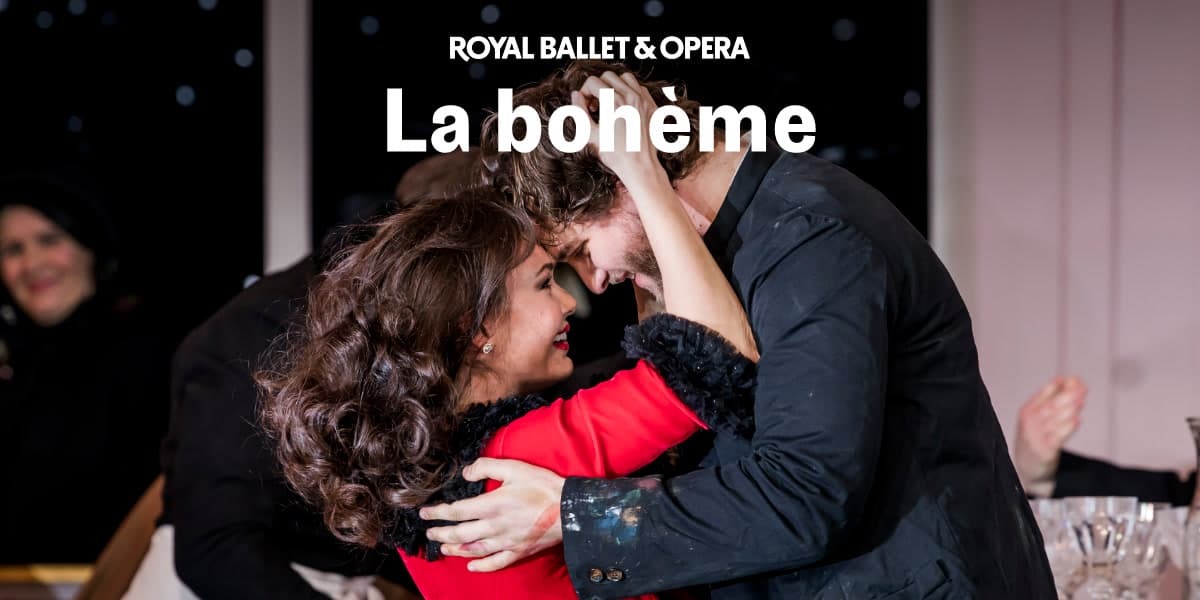
When Rodolfo, a penniless poet, meets Mimì, a seamstress, they fall instantly in love. Rodolfo introduces Mimì to his bohemian friends Marcello, Colline and Schaunard, and the group heads to Café Momus, where Marcello reunites with his ex-girlfriend Musetta. But the happiness of the friends – and of budding romance – is threatened when Rodolfo learns that Mimì is gravely ill. Can the warmth of friendship – and of young love – sustain the group of bohemians through the hardships of a cold winter?
With its Parisian setting, tender exploration of first love and both humorous and heartbreaking celebration of friendship, La bohème captivates audiences time and time again, making it the perfect choice for your first visit to the opera. Richard Jones' beloved staging returns, spotlighting the modernism of Paris on the cusp of monumental change and the intimate lives of the city’s Bohemian dreamers. Featuring soaring duets and poignant laments, Puccini’s breathtaking score is sung here by two brilliant casts, with conductor Lorenzo Passerini making his debut with The Royal Opera and Christopher Willis.
Puccini’s much-loved La bohème La bohème received its world premiere at Turin’s Teatro Regio in 1896 and its Covent Garden debut the following year. Composer Giacomo Puccini was inspired by Henri Murger’s 1851 episodic novel, Scènes de la vie de bohème (‘Scenes of the bohemian life’). The libretto was written by playwright Luigi Illica and poet Giuseppe Giacosa. It is currently one of the best-loved operas worldwide, and the opera most performed at the Royal Opera House.
A timeless love story With its soaring love duets, intimate arias and spectacular chorus scenes, Puccini’s timeless Parisian tale has enduring appeal to audiences throughout the ages. The opera’s beautiful score includes highlights ‘Sì, mi chiamano Mimì’ (Yes, they call me Mimì) and Musetta’s ‘Quando m’en vo’ (When I go along) – and Puccini himself wept at the music of the poignant final scene.